The Engineering of Time
The Engineering of Time: Why the 15-Minute Fryer Pre-Heat is a Legacy Flaw
In the high-stakes environment of a commercial kitchen, every second is a line item on the profit and loss statement. We meticulously optimize ticket times, labor scheduling, and ingredient costs. Yet, most operators still accept one massive, daily inefficiency as the unavoidable “cost of doing business”: the 15-minute fryer pre-heat cycle.
From a culinary perspective, pre-heating is a necessity. But from a thermal engineering perspective, a long pre-heat is a critical flaw. It’s a sign that your equipment is fighting against its own thermal inertia rather than transferring energy efficiently to the cooking medium.
It’s time to challenge the legacy thermodynamics of the commercial kitchen.
The Physics of Thermal Inertia
To understand why traditional gas fryers take so long to reach cooking temperature, you have to look at what they are actually heating. Standard atmospheric burners generate a lot of power (BTUs), but they struggle with heat transfer efficiency.
A significant percentage of that initial energy is lost immediately. It escapes through the flue, heating your kitchen hood and increasing your HVAC load, long before the oil reaches 350°F. The fryer has to overcome the “thermal inertia” of the heavy metal vat and the large volume of cold oil. A long pre-heat isn’t a power issue; it’s a transfer issue.
Enter Solaris: The Physics of “Instant-On”
When we engineered the Solaris gas energy fryer line, we didn’t just try to build a bigger burner. We approached the start-up cycle as a geometry and velocity challenge.
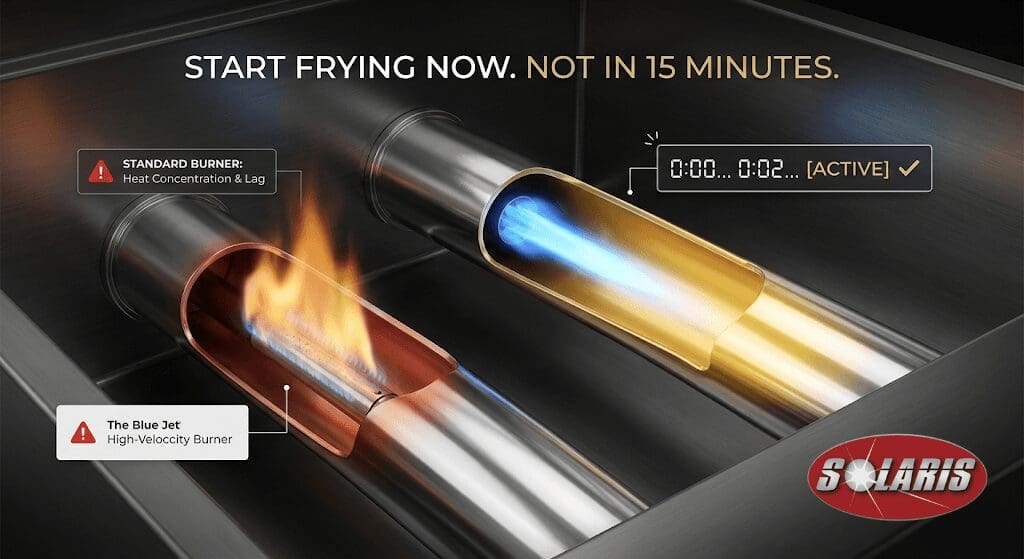
By utilizing high-velocity atmospheric burners paired with optimized baffle plates, we fundamentally shifted how energy is introduced into the system.
Instead of a standard, “lazy” flame that licks the bottom of the heat tubes, the Solaris “Blue Jet” introduces a tight, powerful, and controlled flow of heat. This velocity forces the heat to wrap evenly and instantly around the entire surface area of the heat exchange tubes.
The Operational Impact of Engineering for Speed:
- Reduced Start-Up Waste: By heating the oil directly and minimizing flue loss, Solaris reaches cooking temperatures in a fraction of the time. You save gas every single morning before the first order is even dropped.
- The “On-Demand” Kitchen: The primary reason kitchens leave fryers idling at high temperatures during slow periods is the fear of being caught unprepared by a rush. The rapid responsiveness of Solaris means you can turn units down to an energy-saving idle, knowing they can be “Flash-Activated” back to 350°F almost instantly.
- True Capacity vs. Nameplate Capacity: Real throughput isn’t defined by how many pounds of fries a machine can cook; it’s defined by how quickly it resets after a frozen load is dropped. Solaris’s advanced thermal transfer provides nearly instant temperature recovery, maintaining the crucial “searing zone” and ensuring every basket is perfectly crisp.
Redefining Throughput as a Metric of Time
True efficiency is about maximizing the productivity of every square inch of your kitchen footprint.
Consider the math: If your kitchen saves just 10 minutes of pre-heat time, twice a day, and recovers 30 seconds faster per basket, you aren’t just saving pennies on gas. You are reclaiming valuable production time.
Over the course of a year, that saved time equates to the capacity to serve hundreds of additional orders—all without increasing your labor cost or your hood space.
Engineering for speed is, inherently, engineering for profitability. The era of accepting equipment lag as a baseline requirement is over. The future of frying is “on-demand.”
To learn more about the specific thermodynamics behind the Solaris high-velocity burner technology, or to schedule a demo to see the “Instant-On” effect yourself, contact Entrée LLC today.