
Does Blast Chilling Ruin Taste and Nutrients? The Science Behind the Cold
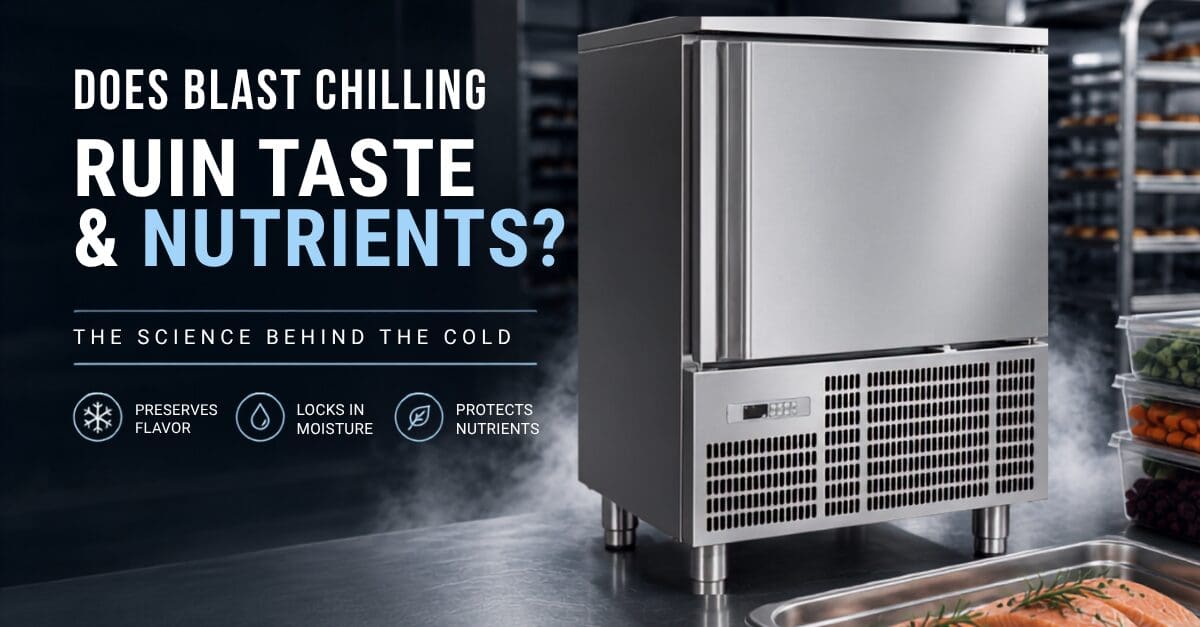
If you run a professional kitchen, manage food production, or take meal prep seriously, you’ve likely encountered the persistent myth: freezing or rapidly chilling food destroys its culinary soul and strips away vitamins.
While that is certainly true for a standard reach-in freezer, blast chilling is an entirely different biological ballgame.
Instead of degrading quality, rapid chilling is one of the most effective food technologies available for locking in farm-fresh flavor, delicate textures, and fragile micronutrients.
The Real Culprit: Ice Crystals and Cell Damage
To understand why standard cooling ruins food, look at what happens at the cellular level during slow freezing.
When hot food cools gradually in a standard refrigerator or freezer, water molecules have ample time to organize into large, jagged, needle-like ice crystals. These sharp crystals act like microscopic blades, puncturing cell walls within meats, vegetables, and cooked sauces.
When you later reheat the food, you get:
- Purge loss: Moisture bleeds out, leaving proteins dry and stringy.
- Nutrient leaching: Water-soluble vitamins drain straight into the pan or container bottom.
- Texture collapse: Crisp vegetables turn mushy, and delicate emulsions break.
Why Blast Chilling Preserves Taste and Texture
A blast chiller works via high-velocity, sub-zero airflow that plunges core temperatures through the “Danger Zone” (140°F to 40°F / 60°C to 4°C) in under 90 minutes, or shock-freezes down to 0°F (-18°C) in under 4 hours.
Because heat is extracted almost instantly:
- Micro-Crystallization: Water molecules freeze so rapidly that they form minuscule, spherical micro-crystals that do not pierce cellular walls.
- Moisture Retention: Juiciness, aroma, and natural fats stay trapped inside the food structure rather than evaporating as steam or leaking as thaw purge.
- Flavor Lock: Volatile aromatic compounds—the delicate molecules responsible for smell and flavor complexity—are captured at peak freshness before oxidation can dull them.
What Happens to the Nutrients?
Contrary to conventional assumptions, blast-chilled food often retains higher nutrient density than food held in standard refrigeration for several days.
| Nutritional Factor | Standard Refrigeration / Slow Cooling | Rapid Blast Chilling |
| Vitamin C & B-Complex | Degrades rapidly via oxidation and water bleed | Preserved; micro-crystallization prevents cellular leakage |
| Antioxidants & Polyphenols | Breaks down over 48–72 hours of slow enzymatic activity | Enzymatic breakdown halted almost instantaneously |
| Macronutrients (Proteins/Fats) | Denatures and oxidizes slowly, drying out texture | Remains structurally intact |
When you blast-chill a batch of roasted seasonal vegetables or braised short ribs straight out of the combi oven, you effectively hit “pause” on food senescence. When reheated properly, the dish delivers the exact flavor profile, bite, and nutritional profile intended on the pass.