
Understanding Your Cold Chain: Merchandiser Freezers vs. Commercial Upright Freezers
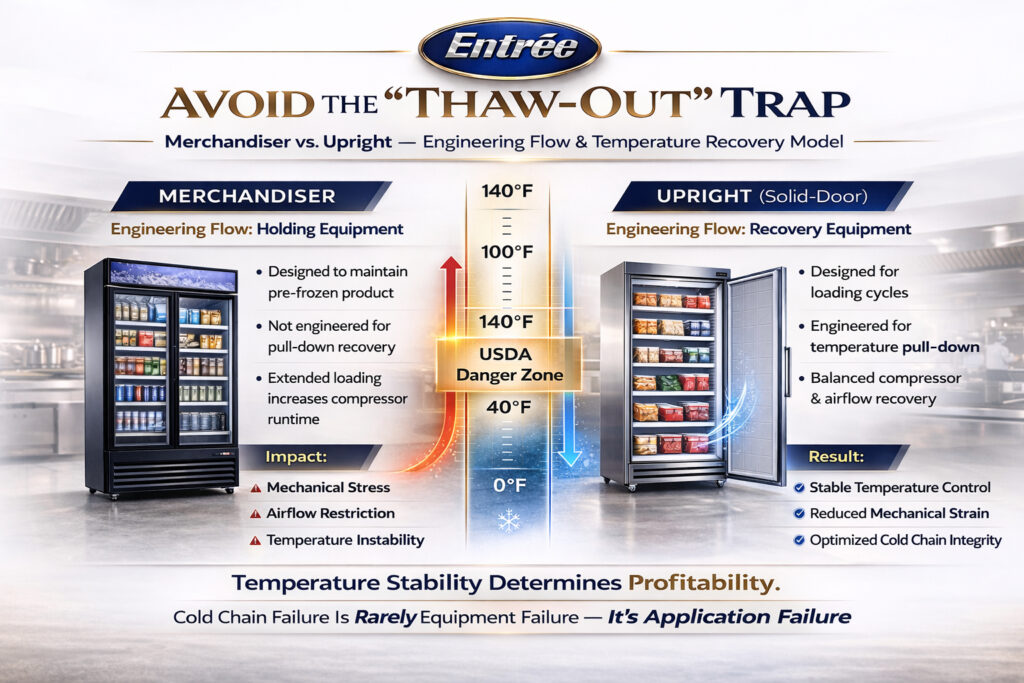
While they might look similar from across a professional kitchen or a convenience store aisle, merchandiser freezers and commercial upright storage freezers (reach-ins) are engineered for fundamentally different roles. At Entrée LLC, we believe there is no such thing as too much information when building your business, and choosing the right equipment starts with understanding that cooling isn’t just about temperature—it’s about balancing product visibility with storage density.
We frequently receive calls from customers who weren’t fully informed about the distinct functions of these two freezer types. Unfortunately, this confusion often leads to unnecessary loss of product, avoidable repair costs, and a great deal of operational frustration. Our goal is to ensure you have the knowledge to avoid those pitfalls.
Here is a breakdown of how these two essential pieces of equipment function and where they fit in your operation.
1. The Merchandiser Freezer: Built to Sell
The primary function of a merchandiser freezer is display. These units are designed to sit in customer-facing areas, using glass doors and specialized lighting to make products look appetizing.
- Temperature Range: Typically holds products at or below -18°C (0°F) to ensure frozen goods like ice cream or pre-packaged meals stay rock-solid.
- The Glass Factor: To prevent fogging, these units use triple-paned, heated glass doors. Without this “anti-sweat” technology, the temperature difference between the store and the freezer would create constant condensation.
- Aesthetics: They feature bright LED internal lighting and often a lighted “sign header” at the top for branding.
The “Holding” vs. “Freezing” Rule
One of the most common mistakes in food retail—and a leading cause of the frustrated calls we receive—is treating a merchandiser freezer like a “flash freezer.” It is vital to understand that a merchandiser is a holding unit, not a pull-down unit.
Why you should only load pre-frozen products:
- Avoiding the “Danger Zone”: Placing room-temperature items in a merchandiser takes too long to reach freezing. This keeps food in the 4°C to 60°C 40°F to 40°F range where bacteria multiply rapidly.
- Preventing Coil Freeze-Up: Unfrozen products release moisture that migrates to the evaporator coils. This creates ice buildup that chokes airflow and can lead to a total unit “thaw-out,” ruining your entire inventory.
- Compressor Health: Forcing a merchandiser to freeze warm products causes the compressor to run 100% of the time, leading to overheating and potential burnout.
- Quality Control: Slow freezing creates large ice crystals that rupture food cell walls, resulting in a mushy, poor-quality product for your customers.
2. The Commercial Upright Freezer: The Kitchen Workhorse
Often called a “reach-in,” the commercial upright freezer is the backbone of the “back-of-house.” Its primary function is safe, high-volume, long-term storage.
- Temperature Range: Designed to keep frozen ingredients safely between -23°C and -18°C (-10°F to 0°F).
- Insulation & Durability: Unlike merchandisers, these usually have solid stainless steel or aluminum doors. Solid doors offer superior insulation and are easier to clean in a messy kitchen environment.
- Powerful Recovery: Commercial kitchens are hot. These units feature heavy-duty compressors and thicker insulation designed for rapid temperature recovery—essential when line cooks are opening and closing the doors constantly during a rush.
+1
- Internal Sanitation: Upright storage freezers are often built with “food zone” interior requirements, making them suitable for open food containers, unlike many merchandisers which are meant only for packaged, sealed goods.
Key Functional Differences at a Glance
| Feature | Merchandiser Freezer | Commercial Upright Freezer |
| Primary Goal | Impulse sales and display | Food safety and bulk storage |
| Door Type | Heated glass (triple-pane) | Solid metal (for maximum insulation) |
| Placement | Front-of-house / Retail | Back-of-house / Kitchen |
| Loading Rule | Pre-frozen products only | Pre-frozen or small-batch prep |
| Cleaning | Easy-clean glass/exterior | Heavy-duty, NSF-compliant interior |
Which one do you need?
The decision usually comes down to location and access frequency.
- Choose a Merchandiser if the customer needs to see the product to buy it. This is ideal for frozen treats, bagged ice, or “grab-and-go” frozen entrees.
- Choose an Upright Freezer if you are storing bulk ingredients, raw proteins, or prepped items that need to stay at a deep-freeze temperature in a high-heat, high-activity kitchen environment where the door is opened frequently.