
The Physics of Beverage Profitability
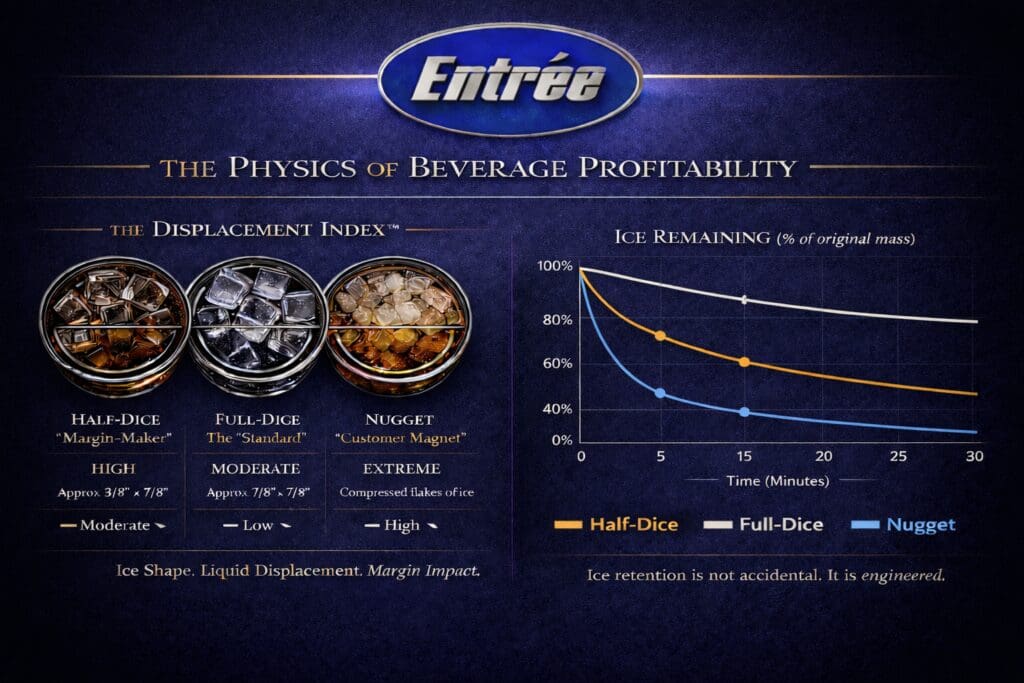
Technical Fact Sheet: The Physics of Beverage Profitability
When choosing a commercial ice machine, the “shape” is a financial decision. Here is how the three most common ice types impact your operational costs and customer experience.
1. The Half-Dice Cube (The “Margin-Maker”)
- Dimensions: Approximately $3/8″ \times 7/8″ \times 7/8″$
- Displacement Factor: High. Because of their thin profile, they “nest” tightly. In a standard 16oz cup, half-dice ice occupies more volume than full cubes, requiring less liquid to appear full.
- Melt Rate: Moderate.
- Best Application: High-volume soda fountains, fast-casual dining, and bagged ice.
- The Bottom Line: Maximizes liquid-to-ice ratios to protect syrup and CO2 margins.
2. The Full-Dice Cube (The “Standard”)
- Dimensions: Approximately $7/8″ \times 7/8″ \times 7/8″$
- Displacement Factor: Moderate. The larger surface area means fewer cubes fit into a glass, leaving larger “air gaps” that must be filled with beverage.
- Melt Rate: Low. The density of a full cube makes it the slowest to melt, preventing drink dilution over longer periods.
- Best Application: Banquet halls, hotel ice dispensers, and fine dining water service.
- The Bottom Line: Provides a premium “clink” in the glass and maintains drink integrity for slow-sipping customers.
3. Nugget / “Chewable” Ice (The “Customer Magnet”)
- Form: Compressed flakes of ice.
- Displacement Factor: Extreme. Nugget ice behaves almost like a fluid; it packs into every corner of the cup.
- Melt Rate: High. Because it is porous, it melts faster, but it absorbs the flavor of the drink—creating the “crunch” that consumers love.
- Best Application: C-stores, healthcare (easy to chew), and specialty iced coffees.
- The Bottom Line: Highest displacement (lowest liquid cost), but requires a specialized evaporator system to produce.
Technical Fact Sheet: The Physics of Beverage Profitability
When choosing a commercial ice machine, the “shape” is a financial decision. Here is how the three most common ice types impact your operational costs and customer experience.
1. The Half-Dice Cube (The “Margin-Maker”)
- Dimensions: Approximately $3/8″ \times 7/8″ \times 7/8″$
- Displacement Factor: High. Because of their thin profile, they “nest” tightly. In a standard 16oz cup, half-dice ice occupies more volume than full cubes, requiring less liquid to appear full.
- Melt Rate: Moderate.
- Best Application: High-volume soda fountains, fast-casual dining, and bagged ice.
- The Bottom Line: Maximizes liquid-to-ice ratios to protect syrup and CO2 margins.
2. The Full-Dice Cube (The “Standard”)
- Dimensions: Approximately $7/8″ \times 7/8″ \times 7/8″$
- Displacement Factor: Moderate. The larger surface area means fewer cubes fit into a glass, leaving larger “air gaps” that must be filled with beverage.
- Melt Rate: Low. The density of a full cube makes it the slowest to melt, preventing drink dilution over longer periods.
- Best Application: Banquet halls, hotel ice dispensers, and fine dining water service.
- The Bottom Line: Provides a premium “clink” in the glass and maintains drink integrity for slow-sipping customers.
3. Nugget / “Chewable” Ice (The “Customer Magnet”)
- Form: Compressed flakes of ice.
- Displacement Factor: Extreme. Nugget ice behaves almost like a fluid; it packs into every corner of the cup.
- Melt Rate: High. Because it is porous, it melts faster, but it absorbs the flavor of the drink—creating the “crunch” that consumers love.
- Best Application: C-stores, healthcare (easy to chew), and specialty iced coffees.
- The Bottom Line: Highest displacement (lowest liquid cost), but requires a specialized evaporator system to produce.