
BEYOND THE CLOCK
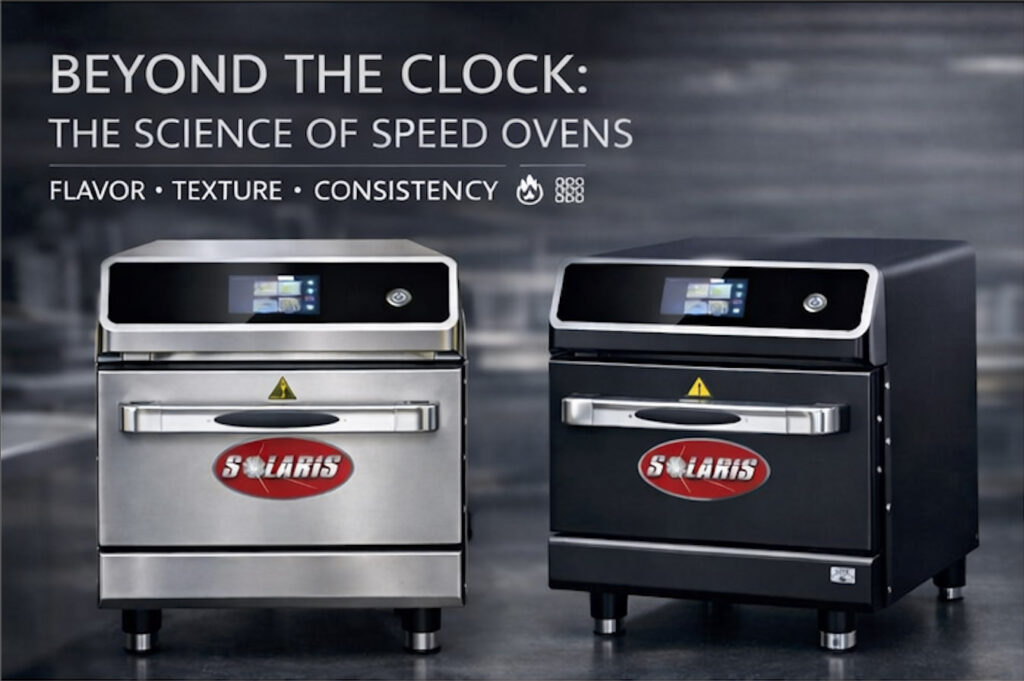
Beyond the Clock: Why Speed Ovens Are the New Standard for Culinary Excellence
In the high-stakes world of commercial foodservice, “speed” was once a dirty word. For years, the industry equated fast cooking with a loss of texture, flavor, and culinary integrity. But as technology has evolved, so has the definition of a high-performance kitchen.
For modern restaurant operators and executive chefs, the speed oven is no longer just a “fast” alternative—it is a precision instrument that often delivers superior consistency compared to traditional methods.
The Science of the “Tri-Power” Method
The magic of a modern speed oven lies in its ability to manage heat transfers that were once thought to be mutually exclusive. By combining Impingement, Convection, and Radio Frequency (RF) Energy, these units attack the cooking process from three angles:
- Surface Perfection: High-velocity impingement air “scrubs” the cold moisture layer off the food’s surface, triggering the Maillard reaction. This ensures that pizzas, proteins, and pastries achieve that gold-standard browning and “crunch” that customers demand.
- Even Distribution: Convection air circulates throughout the cavity, eliminating the cold spots that often plague traditional ovens during high-volume rushes.
- Internal Precision: RF energy penetrates the food to cook the interior rapidly, ensuring the center reaches the ideal temperature at the exact moment the exterior hits peak crispness.
Flavor Preservation: The “Less is More” Principle
One of the most overlooked benefits of speed cooking is moisture retention. In a traditional convection oven, a protein might be subjected to dry heat for 15 to 20 minutes, causing significant juice evaporation and flavor loss.
Because a speed oven slashes cook times by up to 80%, the food spends significantly less time under thermal stress. This results in:
- Concentrated Aromatics: Volatile compounds stay locked inside the dish rather than escaping into the oven cavity.
- Juicier Yields: Steaks and chicken breasts retain their internal moisture, leading to a better mouthfeel and a more premium plate presentation.
Solving the “Texture Paradox”
We have all experienced the “microwave effect”—that dreaded rubbery, soggy texture caused by internal steaming. Speed ovens solve this paradox through simultaneous heat application. While the internal energy heats the core, the impingement air creates a dry, toasted barrier. This creates the perfect contrast: a crackly, toasted crust with a soft, tender interior.
[Image diagram showing heat transfer in a speed oven: convection, impingement, and microwave energy]
The Verdict: Consistency is the New King
In today’s labor market, the ability to deliver a “perfect” product every single time—regardless of who is behind the line—is the ultimate competitive advantage. By leveraging programmable logic and multi-mode heating, speed ovens remove human error and deliver a level of consistency that traditional equipment simply cannot match.
For the knowledgeable operator, the speed oven isn’t just a way to save time; it’s a way to save your brand’s reputation for quality.
About the Author
Patricia Casimir is the President of Entree LLC, a leader in commercial kitchen innovation. Entree LLC is dedicated to providing high-performance equipment, including the upcoming Solaris line, designed to help chefs push the boundaries of speed and quality.